

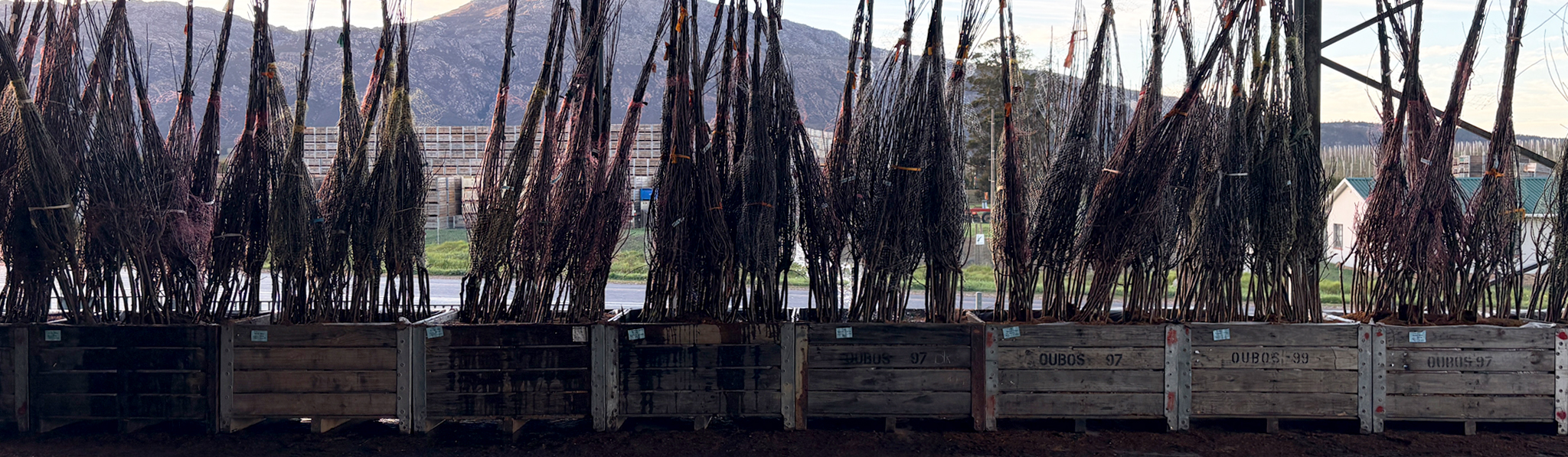
During August, a new generation of apple trees arrived at Betko. Destined for planting on our farms, the young trees first spend some time at our facilities before making their way to the orchards.
Renewing orchards is an important part of long-term fruit production, particularly on older farms. Commercial apple orchards typically have an economic lifespan of around 20 to 25 years, although individual trees can remain productive for longer. Over time, older orchard blocks need to make way for new plantings that will form part of the farm’s production for many years to come.
The process starts long before a tree is planted in the orchard. The young apple trees arrive from the nursery during winter as dormant, bare-root trees. Unlike a potted tree, a bare-root tree is transported without soil surrounding its root system. This makes careful handling between the nursery and planting particularly important, as the exposed roots need to be protected from drying out.
Once the trees arrive at Betko, plastic-lined bins are partially filled with a layer of fine sawdust. The trees, bundled together in groups of ten, are placed into the bins before additional sawdust is carefully filled in around the root systems. The bins are then thoroughly watered, allowing the sawdust to retain moisture around the roots without leaving them waterlogged.
From there, the bins are moved into cold storage until the farms are ready for planting. There is another reason for keeping the trees cold during this period. Apple trees are deciduous and enter dormancy during winter. During this time, they need sufficient exposure to cold temperatures before they can resume normal growth when warmer conditions return. This accumulated exposure is commonly referred to as winter chill.
Sufficient winter chill contributes to more uniform bud break, flowering and leaf development in spring. This is particularly relevant to our apple-growing areas in the Overberg, where winter conditions are relatively mild compared with some of South Africa’s colder production regions. Keeping the dormant nursery trees under controlled cold conditions allows them to continue accumulating valuable chill before they are planted. While in storage, the sawdust is monitored and watered when necessary to ensure that the roots remain moist until planting time.
There is also an interesting detail visible on the trees themselves. Look closely near the base of the trunks and you will notice different coloured paint markings. These markings have a practical purpose. Under South Africa’s Deciduous Fruit Plant Certification Scheme, prescribed colour markings are used on certified nursery trees to identify plant material around the graft union and assist with traceability.
Commercial apple trees are generally made up of two parts joined through grafting. The rootstock forms the root system and influences characteristics such as the eventual size and vigour of the tree. The scion, grafted onto the rootstock, is the chosen fruiting variety and determines which apples the tree will eventually produce. Correct identification is therefore important long before the first fruit appears.
When planting time arrives, the trees will leave Betko and make their way to the farms. There, each young tree will be planted into its permanent position and begin establishing the root system and structure that will support it through future seasons. It will still take several years before these trees reach meaningful commercial production, making orchard renewal an investment well into the future.
Eventually, the journey comes full circle. The apples produced by these young trees will make their way back to Betko, this time not as dormant nursery trees, but as fruit ready to be packed.
It is a long journey from a bundle of bare-root trees in a bin of sawdust to a productive apple orchard, and this careful preparation is where that journey begins.