

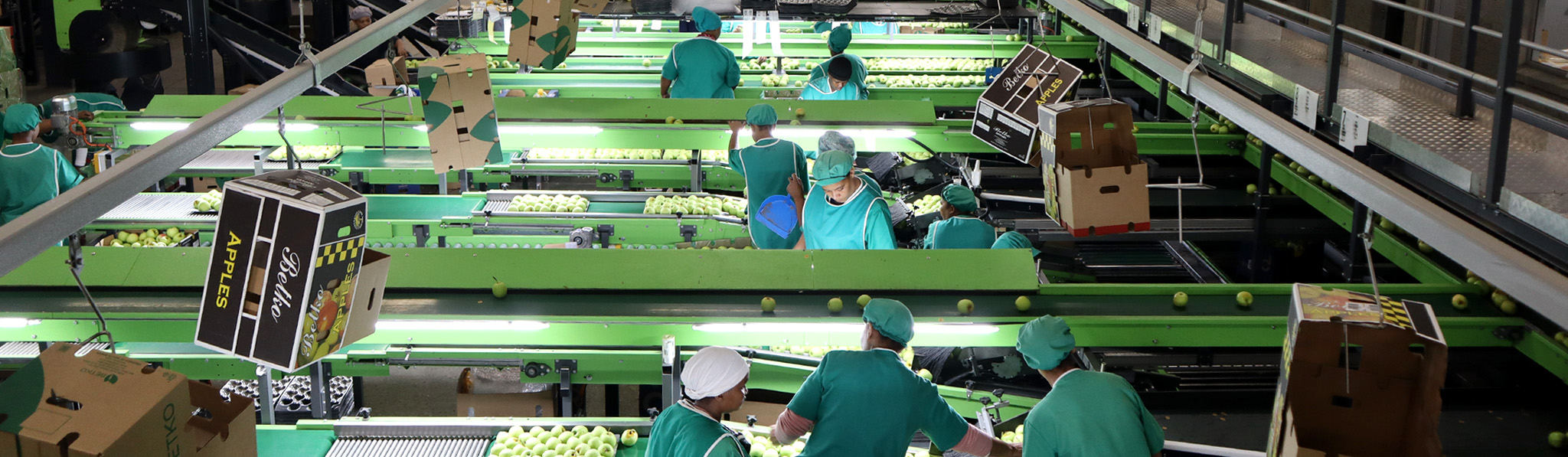
February marks the heart of the apple and pear season in South Africa. Orchards are active, trucks are moving, and packhouses are operating at full pace again as fruit arrives steadily from the farms.
This is the stage of the season where planning meets reality. Decisions are made quickly, quality is assessed continuously, and teams across the operation work together to keep fruit moving efficiently from intake through packing and into dispatch.
By February, the pace of work settles into a rhythm. Volumes increase, packlines run longer hours, and coordination becomes critical. Each load of fruit represents weeks and months of work in the orchard, and once it arrives at the packhouse, timing and precision matter more than ever.
Sorting, grading, packing, and dispatch all need to happen without delay to protect fruit quality and meet market requirements. Small inefficiencies can quickly add up, which is why clear processes and experienced teams are essential during this phase.
This year has also highlighted how unpredictable ripening patterns are becoming across the industry. In some cases, the order in which apple cultivars normally mature has shifted. Where early cultivars such as Panorama Goldens are typically the first to be harvested, later cultivars like Bingo have arrived earlier than expected.
These changes are not isolated and have been noted by other growers in the region as well. Factors such as a drier-than-normal winter, uneven chill accumulation, later or staggered blossom, and temperature patterns during early fruit development can all influence how quickly different cultivars progress. For us, this means staying alert and adjusting intake and packing plans as conditions change.
When the usual sequence shifts, the effects are felt throughout the supply chain. Harvest planning, packhouse intake, quality assessment, cold storage allocation, and dispatch scheduling all need to adjust in real time.
As harvest volumes peak, the pressure does not stop at the packhouse doors. Logistical pressure at the port adds another layer of complexity during this phase of the year. As volumes increase, challenges at the Cape Town harbour, including congestion, weather-related disruptions, and vessel scheduling constraints, can impact export timelines.
These delays are not unique to a single exporter and are being felt across the industry. For packhouses and logistics teams, this means careful coordination, contingency planning, and constant communication to ensure fruit quality is maintained while navigating unavoidable bottlenecks.
February is not about slowing down, but about maintaining the high standards to which we hold ourselves accountable, year in and year out. With higher volumes moving through the system, quality control plays a key role. Fruit is assessed continuously to ensure it meets the required specifications, whether destined for local markets or export programmes.
From how fruit is handled at intake to how it is packed and dispatched, every step has an impact on the final outcome and on how the fruit performs further down the supply chain.
Behind the machinery and systems are people putting in long hours. February demands focus, stamina, and teamwork. Our packhouse staff, quality controllers, maintenance teams, and logistics teams all play a role in keeping the operation running smoothly under peak pressure.
The ability to adapt quickly, communicate clearly, and support one another is what keeps operations moving when conditions change. External factors such as weather conditions, logistics constraints, and shifting market demands can evolve daily, requiring constant adjustment and problem-solving.
While February is firmly rooted in the present, the way fruit is handled now has a direct influence on what follows. Decisions made at this stage affect storage outcomes, market performance, and how the remainder of the year unfolds.
For us at Betko, this period is about doing the work properly, staying focused on quality, and relying on the knowledge and experience our teams have built over time. As conditions become less predictable, working closely across every part of the operation and responding with care and precision becomes just as important as the fruit itself.